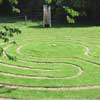
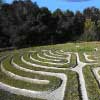
A labyrinth is not a maze. It has only one path to the center and back out, which is called unicursal (one line). It has no blind alleys or dead ends as mazes have. The path twists and turns back on itself many times before reaching the center. Once at the center, there is only one way back out.
The labyrinth symbolizes a journey to a predetermined destination (such as a pilgrimage to a holy site), or the journey through life from birth to spiritual awakening to death.
History
Labyrinth images are found in many cultures. The term is of ancient Greek origin and the labyrinth in the palace of Knossos in Crete figures in Greek mythology. It is found in Hindu and Hopi images, among many others.
In Christian usage, a labyrinth was constructed in stone in the floor of Chartres Cathedral near Paris, around the year 1200 A.D. The faithful could make a pilgrimage journey to the cathedral and complete it by walking the labyrinth as the final symbol of a journey to the Holy Land.
It was also used as an act of repentance for sins. The penitent might walk it on their knees. Labyrinths are found in many Gothic cathedrals throughout Europe.